
Why Korean-Indonesian Flavor Crossover Is the Fastest-Growing Segment on Asian Grocery Shelves
The Category Shift Driving Demand for Korean-Indonesian Instant Noodles in the US
How K-pop Culture and Korean Media Created a Hunger for Bold Spicy Noodles Among US Shoppers
The numbers are not subtle. Korean instant noodles, spicy noodle formats, and buldak spicy noodles have moved from specialty endcaps to mainstream planogram real estate inside three years. K-pop, Korean drama streaming, and viral food content have done what no trade campaign could: they built a conditioned craving for bold, heat-forward flavors across every US consumer demographic. Gen Z shoppers now walk into Asian wholesale grocery stores with specific flavor intent. They know what buldak cheese tastes like. They want spicy ramen noodles with umami depth and a satisfying heat finish. They are not browsing. They are buying.
Why Indonesian Brands Are Uniquely Positioned to Capitalize on the Korean Flavor Wave
Here is the category insight most buyers are still sleeping on. Indonesian noodle brands carry decades of proven flavor engineering in the spicy, savory, and fried noodle space. Mi goreng ramen formats and instant laksa profiles are already shelf-proven in Asian food imports markets globally. When an Indonesian brand applies that flavor foundation to Korean-inspired profiles, the result is not a copycat product. It is a category expansion that gives retailers a halal-certified, competitively priced alternative with real brand equity behind it. Mi Sedaap noodles, produced by Wings Food and distributed in the US as Mi Sedaap USA, brings exactly that combination to American shelves.
The Role of Social Media and Gen Z Buying Behavior in Accelerating Shelf Velocity
Seasoning mix brands for Gen Z live and die on TikTok Shop velocity. Dry ramen snack content, noodle snacks challenges, and instant noodle snack reviews are generating millions of views per week. That content is converting directly to cart adds. Retailers who stocked korean hot chicken noodle variants twelve months ago saw measurable turns acceleration before their next reset. The window between social signal and shelf placement is compressing fast. Category managers who wait for the next planogram cycle are already behind.
What Makes the Korean-Indonesian Flavor Crossover Distinct from Other Asian Noodle Products
Flavor Architecture: How Mi Sedaap USA Builds Korean-Inspired Profiles with Indonesian Brand Equity
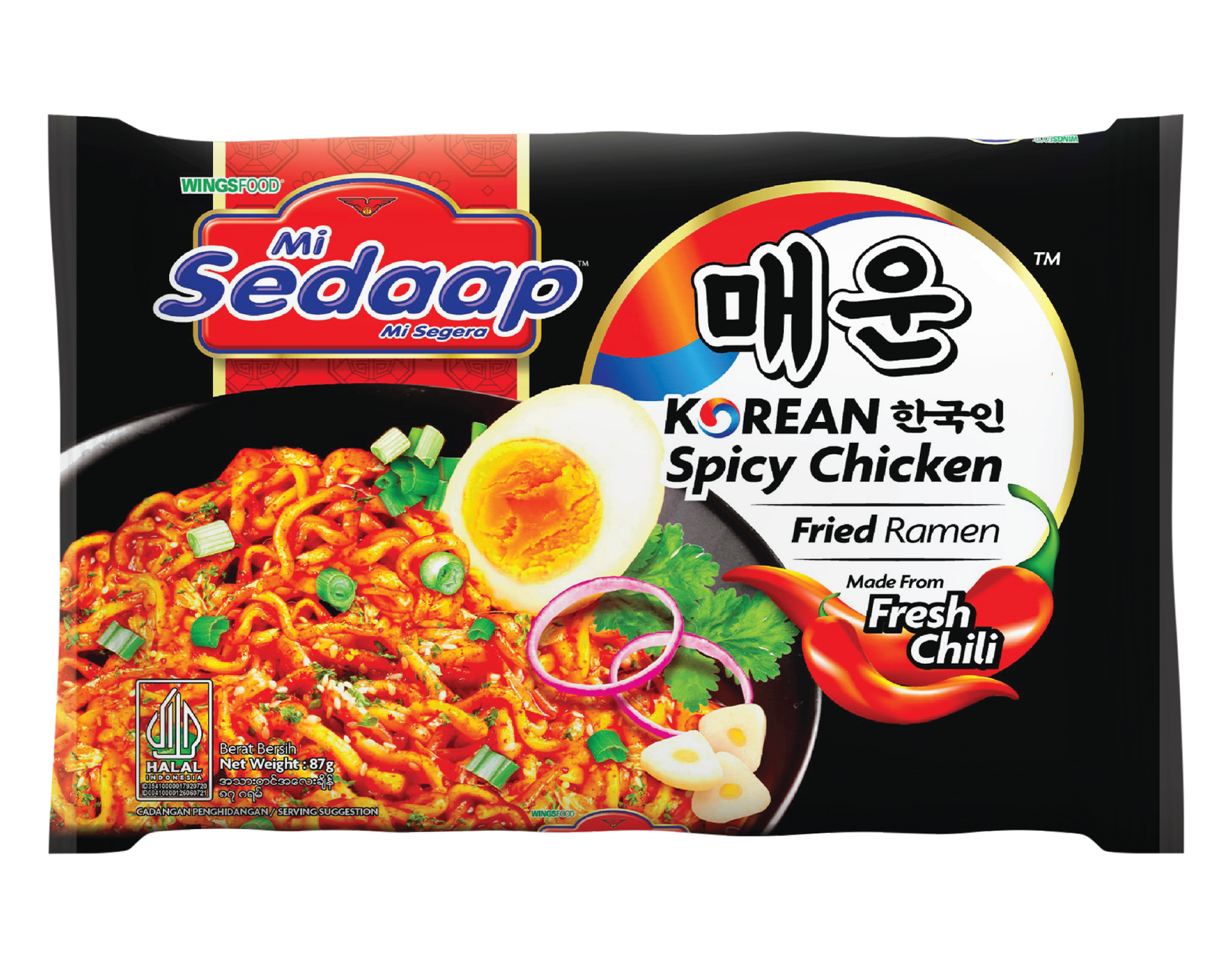
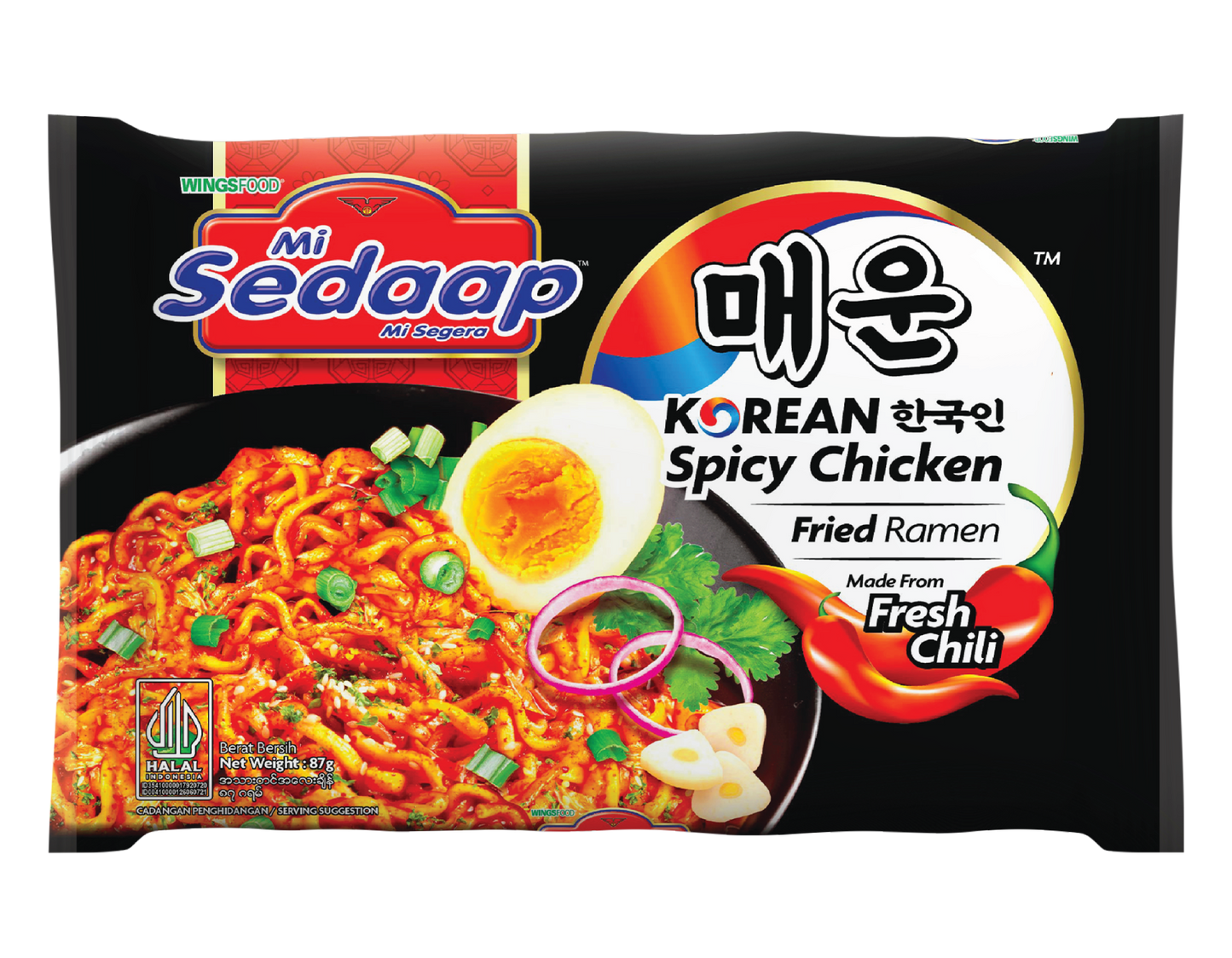
The Mi Sedaap Korean Spicy Chicken delivers bold Korean-style heat with a savory chicken base, umami depth, and a slight sweetness that rounds the finish. A dried seaweed topping adds texture and visual appeal that photographs well, which matters for shelf-influenced social discovery. The Mi Sedaap Korean Cheese Buldak Spicy variant layers buldak-style heat under a creamy cheese coating, hitting the buldak cheesy flavor profile that has driven so much search volume around terms like buldak cheesy ramen and cream carbonara buldak noodles. These are not one-dimensional heat products. They are built with flavor architecture that rewards repeat purchase.
Beyond the Korean crossover line, the broader Mi Sedaap portfolio reinforces the brand's versatility. The Singaporean Spicy Laksa brings creamy coconut broth with aromatic laksa spice for shoppers seeking instant laksa options. The Spicylicious variant offers a dual-chili experience with a green chili sauce and crispy fried onion topping. Sedaap noodles across every SKU are halal certified under MUI, ISO 22000 compliant, and HACCP certified, which matters enormously for retail compliance across national and regional chains.
Key SKUs Driving the Trend Including Korean Spicy Chicken and Korean Cheese Buldak Spicy Variants
The Mi Sedaap Cup Korean Spicy Chicken gives buyers a korean noodle cup format that is ready in five minutes with no-broth dry noodle construction. The cup noodles korean format is critical for capturing impulse and convenience shoppers. The bag format Mi Sedaap Korean Spicy Chicken extends the same profile for shoppers cooking at home. Both SKUs address distinct consumption occasions and should anchor any Korean-Indonesian crossover section.
Why Halal Certification and ISO Standards Give Mi Sedaap a Competitive Retail Advantage
Halal noodles represent a growing compliance requirement for retailers serving Muslim-majority communities and health-conscious shoppers who use halal as a quality signal. MUI halal certification combined with ISO 22000 and HACCP standards gives category managers documentation that simplifies vendor onboarding. For buyers sourcing asian food imports at scale, that compliance stack reduces friction at every stage of procurement.
B2B Opportunity Analysis: Stocking Korean-Indonesian SKUs for Maximum Shelf Performance
Category Data and Shelf Velocity Insights for Grocery Buyers and Category Managers
Bowl noodles and cup noodle formats are outperforming bag noodles in convenience-driven retail environments. Korean instant noodles spicy variants consistently rank among the best instant noodle performers in Asian grocery environments. The korean instant noodle category as a whole is growing, but the crossover segment combining Indonesian brand trust with Korean flavor profiles is growing faster. Mie sedaap noodles are already pulling turns in 99 Ranch locations and on Amazon, creating proof-of-performance data that de-risks the shelf decision for regional buyers.
|
SKU |
Format |
Key Certifications |
|---|---|---|
|
Mi Sedaap Korean Spicy Chicken |
Bag, Cup |
Halal (MUI), ISO 22000, HACCP |
|
Mi Sedaap Korean Cheese Buldak Spicy |
Bag |
Halal (MUI), ISO 22000, HACCP |
|
Mi Sedaap Singaporean Spicy Laksa |
Bag |
Halal (MUI), ISO 22000, HACCP |
|
Mi Sedaap Spicylicious |
Bag |
Halal (MUI), ISO 22000, HACCP |
|
Mi Sedaap Original Fried Noodles |
Bag, Cup |
Halal (MUI), ISO 22000, HACCP |
Supply Chain and Import Logistics Advantages of Sourcing Mi Sedaap USA Through Established Distributors
Sourcing noodles in usa through established asian food distributors eliminates the compliance and lead time risk that comes with direct import. Mi Sedaap USA products are available through distribution networks that have already handled customs clearance, labeling compliance, and cold-chain integrity for the broader asian food imports category. For a food wholesaler or snack distributor managing multiple SKUs, consolidating Mi Sedaap into an existing asian wholesale grocery order is operationally efficient.
Wholesale and Private Label Opportunities for Asian Grocery Chains and Regional Distributors
Wholesale asian food distributors servicing regional chains can position Mi Sedaap as a velocity driver alongside indomie mi goreng and established ramen noodles. For buyers ready to act now, Shop Mi Sedaap Wholesale to explore bulk pricing, case quantities, and distributor terms directly.
How Retailers and Distributors Can Activate the Mi Sedaap USA Opportunity Right Now
Recommended SKU Mix for Asian Grocery Chains Targeting Korean Flavor Demand
Lead with the Mi Sedaap Korean Spicy Chicken bag and cup formats for core korean spicy noodles demand. Flank with the Korean Cheese Buldak Spicy for shoppers searching buldak cheese and buldak toppings options. Add the Spicylicious for spicy noodle breadth and the Singaporean Spicy Laksa for broth-format variety. The Mi Sedaap Original Fried Noodles and Soto Mie round out the set for shoppers seeking authentic Indonesian profiles alongside korean soup packets alternatives.
How to Partner with Asian Food Distributors and Food Wholesalers for Seamless Procurement
Regional buyers and wholesale distributors should connect with a verified Asian Food Distributor to confirm availability, minimum order quantities, and freight terms for their market. Working through an established indonesian food distributor usa network ensures product arrives in compliance and on time, whether you are an asian food distributor california operation or a national chain.
Building a Winning Planogram Strategy Around Korean-Indonesian Crossover Noodle Products
Place Mi Sedaap Korean Spicy Chicken and Korean Cheese Buldak adjacently on shelf to anchor the crossover section. Use the cup formats at eye level for impulse capture. Support with shelf talkers referencing halal certification and the cheese powder for ramen and cream carbonara ramen flavor profiles that resonate with Gen Z shoppers. The spiciest noodles korean search trend is driving discovery. Your planogram should capture that intent the moment shoppers enter the aisle.
FAQ
What makes Korean-Indonesian flavor crossover noodles a high-velocity category for US Asian grocery retailers right now?
Korean spicy noodles instant formats have built enormous search and purchase momentum through K-pop culture and social media. Indonesian brands like Mi Sedaap bring halal certification, ISO compliance, and a flavor heritage that translates Korean spice profiles with genuine depth. The result is a segment with proven consumer pull and shelf velocity data to support the buy decision.
How does Mi Sedaap USA differentiate its Korean spicy noodles from established Korean brands on retail shelves?
Mi Sedaap USA offers MUI halal certification, ISO 22000, and HACCP compliance as retail-ready credentials. The Korean Cheese Buldak Spicy and Korean Spicy Chicken SKUs deliver buldak cheesy and spicy noodles buldak flavor profiles within an Indonesian brand equity framework, giving category managers a distinct, compliant, competitively priced option in the korean instant noodles spicy set.
What wholesale and distribution options are available for retailers looking to stock Mi Sedaap USA products in bulk?
Buyers can access wholesale pricing and case quantities directly through established wholesale distributors and asian food imports networks. Mi Sedaap products are available on the brand website, Amazon, and TikTok Shop, with bulk and distributor inquiries supported through verified food wholesaler partners serving asian wholesale grocery accounts nationwide.
Which Mi Sedaap USA SKUs perform best in Asian grocery environments and what consumer demographics drive their sales?
The Mi Sedaap Korean Spicy Chicken and Korean Cheese Buldak Spicy are top performers in asian grocery environments. Gen Z shoppers and Korean food culture enthusiasts drive the highest velocity. The mie sedaap noodles original fried and soto mie variants perform strongly with Southeast Asian diaspora shoppers seeking authentic sedaap noodles and mi goreng ramen profiles.
How can food distributors and wholesale buyers get started sourcing Mi Sedaap USA products for regional or national distribution?
Connect with an established indonesian food distributor usa or asian food distributor california network to confirm regional availability. For direct wholesale inquiry, visit the Mi Sedaap USA website. For distributor-level sourcing, work with a verified asian food distributor to integrate mi sedaap usa into existing instant ramen noodles and spicy ramen noodles category orders.