
Why the Indonesian Diaspora Is a Bigger Market Than Most U.S. Retailers Realize
The Scale of the Indonesian Diaspora in the United States
How Many Indonesians Are Living in the U.S. and Where They Cluster
There are approximately 120,000 to 150,000 Indonesian-born immigrants living in the United States, with broader estimates of the total Indonesian American community, including second and third generation, reaching well above 300,000. They concentrate in Los Angeles, the San Francisco Bay Area, New York, Houston, and Seattle. Southern California alone represents one of the densest clusters, which is part of why the asian food distributor los angeles market has grown so consistently in recent years. These are not scattered households. These are communities with established cultural infrastructure, mosques, community organizations, and food preferences that do not compromise.
Purchasing Power and Spending Patterns of Indonesian American Households
Indonesian Americans index high for household income and educational attainment relative to the broader immigrant population. These are not price-sensitive buyers looking for the cheapest bowl noodles on the shelf. They are brand-loyal consumers who will pay for authenticity and will travel out of their way to find it. When they cannot find it locally, they order online. When they do find it locally, they come back every single week. That pattern is exactly what category managers should be mapping against foot traffic and basket size data.
Why This Consumer Segment Demands Authentic Products Not Local Substitutes
An Indonesian American shopper who grew up eating mie sedaap or mie sedaap noodles in Jakarta does not want a different noodle with a vaguely similar seasoning mix. They want the exact product. This is the defining characteristic of diaspora retail demand. It is not aspirational. It is emotional and specific. Sedaap noodles mean something to this consumer in a way that no substitute can replicate. That loyalty is a retail asset that has been sitting uncaptured on category planning spreadsheets for years.
The State of Southeast Asian Grocery Demand in U.S. Retail
How the Indonesian Food Market USA Has Grown Beyond Ethnic Aisles
The indonesian food market usa is no longer confined to small specialty importers and weekend markets. It is moving into mainstream retail, driven by the convergence of diaspora demand and a general American consumer appetite for bold global flavors. Southeast asian grocery demand has accelerated meaningfully, and the instant noodle category has become the entry point for that shift. Spicy noodles, instant laksa, and globally inspired cup noodle formats have shown up in major retail chains not as curiosities but as consistent sellers.
Distribution White Space Beyond Major Metro Markets
Here is what the data signals clearly: most of the stocking for Indonesian and broader Asian noodle products remains concentrated in a handful of major markets. Wholesale asian food distributors usa coverage drops significantly outside of Los Angeles, New York, and Houston. That means a food wholesaler or wholesale distributor operating in mid-sized markets across the Southeast, Midwest, or Mountain West has meaningful first-mover runway. The Indonesian and Southeast Asian community is more distributed than most retail buyers assume. Food distributors near me searches from Indonesian American households in cities like Columbus, Denver, and Raleigh tell a story of underserved demand that is actively looking for a retailer to meet it.
What Retail Buyers Are Missing in the Southeast Asian Grocery Category
Most retail buyers are still treating the Southeast Asian grocery category as a sub-segment of a broader Asian aisle, behind korean instant noodle and ramen noodles in priority. That sequencing made sense five years ago. It does not make sense today. Consumers who are buying korean spicy noodles instant, spicy ramen noodles, and buldak spicy noodles have already demonstrated that they will explore the full heat-forward instant noodle shelf. Indonesian formats are a natural and commercially logical next step.
Mi Sedaap USA and the Product Portfolio Built for Retail Growth
Mi Sedaap Original Fried Noodles as the Anchor SKU for Retailers
Mi Sedaap USA is the flagship Indonesian instant noodle brand available in the U.S. market, and Mi Sedaap Original Fried Noodles is where every retail set should begin. It delivers bold sweet savory flavor, a signature crispy fried onion topping, and umami-rich seasoning in a format that is ready in five minutes. For the diaspora shopper, this is comfort in a packet. For the mainstream shopper discovering mi goreng ramen or indomie mi goreng style formats for the first time, it is an immediately appealing best instant noodle option with clear differentiation from korean instant noodles.
Expanding the Set with Soto Mie, Korean Spicy Chicken, and Singaporean Spicy Laksa
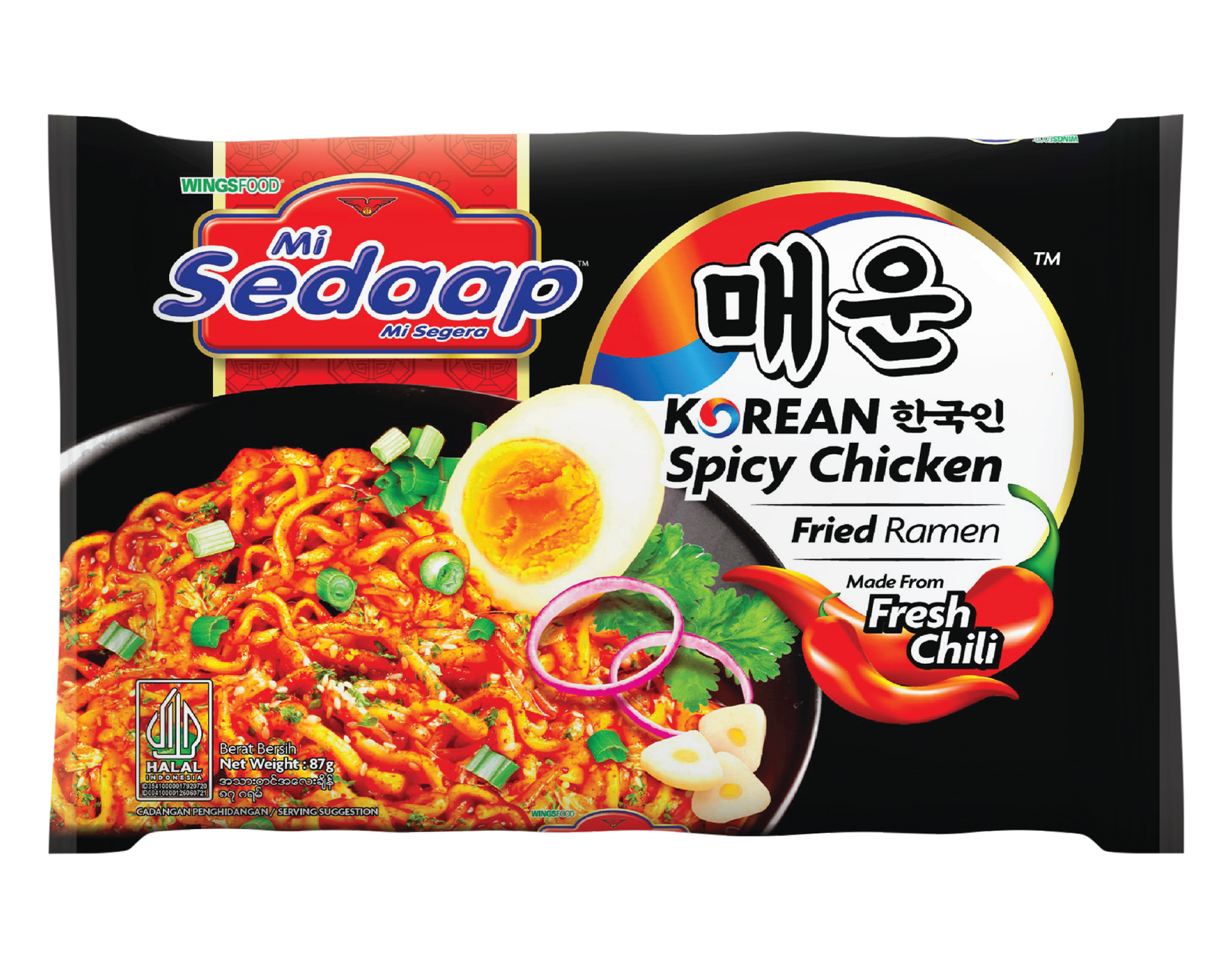
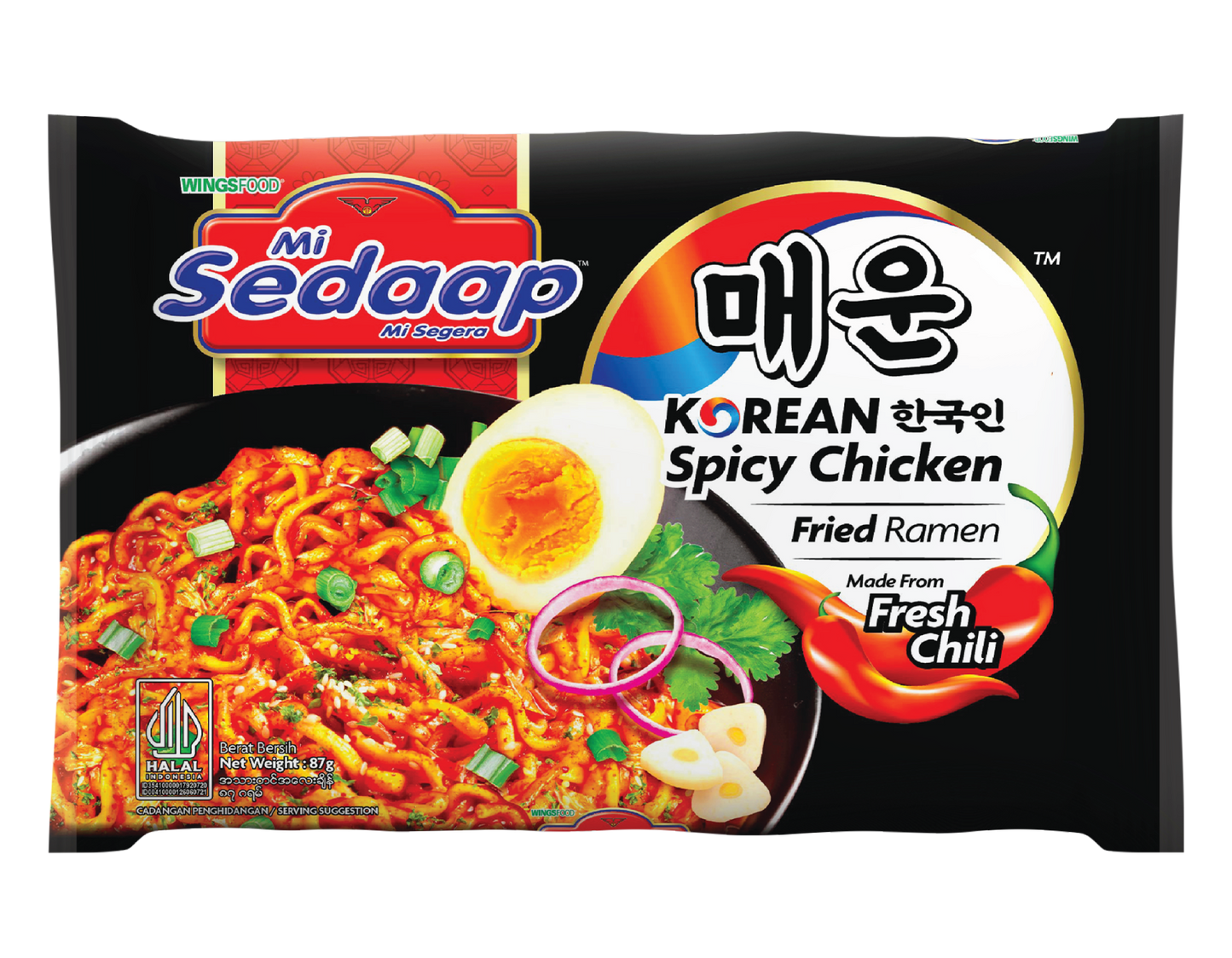
Retailers who want to build a complete Indonesian set have strong options beyond the anchor SKU. Mi Sedaap Soto Mie brings a classic Indonesian soto broth with aromatic spices and a subtle citrus lift from lime leaves, a comforting and approachable entry point for shoppers who prefer something lighter than spicy noodles. Mi Sedaap Korean Spicy Chicken delivers bold heat with a savory chicken base, dried seaweed topping, and umami depth that speaks directly to the consumer already buying korean hot chicken noodle formats and korean noodle cup products. Mi Sedaap Singaporean Spicy Laksa offers a creamy coconut broth with a rich aromatic laksa spice blend that stands out in any instant laksa or bowl noodles set. The Korean Cheese Buldak Spicy variant layers buldak-style heat with a creamy cheese coating, positioning it alongside buldak cheese and buldak cheesy ramen formats that are already proven velocity drivers on shelf.
|
Product |
Format |
Key Flavor Profile |
Certifications |
|---|---|---|---|
|
Mi Sedaap Original Fried Noodles |
Packet |
Sweet savory, crispy fried onion |
Halal MUI, ISO 22000, HACCP |
|
Mi Sedaap Soto Mie |
Packet |
Light chicken broth, lime leaves |
Halal MUI, ISO 22000, HACCP |
|
Mi Sedaap Korean Spicy Chicken |
Packet |
Spicy chicken, seaweed |
Halal MUI, ISO 22000, HACCP |
|
Mi Sedaap Singaporean Spicy Laksa |
Packet |
Creamy coconut, chili heat |
Halal MUI, ISO 22000, HACCP |
|
Mi Sedaap Korean Cheese Buldak Spicy |
Packet |
Buldak heat, creamy cheese |
Halal MUI, ISO 22000, HACCP |
|
Mi Sedaap Cup Korean Spicy Chicken |
Cup |
Spicy chicken, dry noodle format |
Halal MUI, ISO 22000, HACCP |
|
Mi Sedaap Cup Soto |
Cup |
Light soto broth, citrus |
Halal MUI, ISO 22000, HACCP |
|
Mi Sedaap Cup Original Fried |
Cup |
Sweet savory, fried onion |
Halal MUI, ISO 22000, HACCP |
Halal Certification, ISO 22000, and HACCP as Retail Compliance Advantages
Every Mi Sedaap product carries Halal certification from MUI, ISO 22000 food safety certification, and HACCP compliance. For retail buyers managing a halal noodles set or expanding into Muslim American consumer segments, these certifications remove the primary compliance friction. They also signal product integrity to a broader set of health-conscious shoppers who treat third-party certification as a proxy for quality. This is a retail stocking decision that arrives already compliant.
Crossover Appeal and the Mainstream Shopper Opportunity
How Second-Generation Indonesian Americans Are Driving Broader Demand
Second-generation Indonesian Americans are the bridge between community demand and mainstream retail growth. They grew up with sedaap and mi noodles at home, and they are now shopping at 99 Ranch, mainstream grocers, and ordering through TikTok Shop and Amazon. They are also sharing on social media, creating organic visibility for mi sedaap noodles and noodle snacks in front of audiences that include no Indonesian heritage at all. This is how instant noodle snack formats cross over.
Why Spicy Noodles and Global Flavors Are Trending Across All Demographics
The consumer who buys korean soup packets on Monday, dry ramen snack packs on Wednesday, and spicy noodle varieties on Friday is not a niche consumer. They are the new mainstream instant noodle buyer. They are already familiar with cream carbonara ramen, buldak toppings, cream carbonara buldak noodles, buldak cheesy formats, cheese powder for ramen applications, and korean instant noodles spicy varieties. Indonesian instant noodles, and specifically the spiciest noodles formats, fit directly into that rotation. The seasoning mix brands for gen z conversation is already happening, and Mi Sedaap belongs in it.
Positioning Indonesian Instant Noodles as a Growth Category
Indonesian instant noodles are not a niche product waiting for the right moment. They are a growth category with a proven consumer base, rising crossover demand, and a product set that competes on flavor, format, and compliance. Cup noodles korean formats have demonstrated that the cup noodle occasion extends beyond any single cuisine. Instant noodle usa sales data confirms that the broader category rewards variety and bold flavor. Indonesian formats are the next logical expansion of that shelf.
How U.S. Retailers and Wholesale Distributors Can Act on This Opportunity
Partnering with an Asian Food Distributor to Access the Indonesian Category
Wholesale distributors and grocery buyers looking to stock the Indonesian instant noodle category do not need to rebuild their import infrastructure. Established asian food distributors already carry Southeast Asian CPG brands at scale. For buyers in Southern California and beyond, Jans Food is a trusted asian food distributor that supports retail stocking of authentic Asian food brands including Indonesian CPG, and can help buyers navigate wholesale asian food distributors networks efficiently.
Wholesale and Retail Stocking Strategies for Indonesian CPG Brands
Start with the anchor SKU. Mi Sedaap Original Fried Noodles and Mi Sedaap Cup Original Fried establish the Indonesian set with proven velocity among diaspora shoppers. Expand into Korean Spicy Chicken and Singaporean Spicy Laksa to attract crossover demand. Use halal noodles certification as a category merchandising tool to reach Muslim American shoppers. Wholesale chips distributors and food wholesaler accounts that already move high volumes of instant noodles and noodle snacks can add Indonesian formats with minimal category disruption and meaningful upside. Wholesale potato chips buyers may also find that the snackable dry noodle formats, similar to instant noodle snack and dry ramen snack positioning, fit naturally into their existing snack sets.
Next Steps for Grocery Buyers and Category Managers Ready to Expand
The opportunity is not hypothetical. The consumer is already there, already searching, and already buying where they can find the product. Visit Mi Sedaap USA to review the full product portfolio, wholesale availability, and retail stocking options. Then contact an established distribution partner to confirm availability and minimum order quantities for your region. The category is open. The consumer is ready. The shelf space is the only missing variable.
FAQ
How large is the Indonesian diaspora population in the United States and does it represent a viable retail market?
The Indonesian-born population in the United States is estimated between 120,000 and 150,000, with the broader Indonesian American community exceeding 300,000 when second and third generation households are included. They are concentrated in Los Angeles, the Bay Area, New York, Houston, and Seattle, which aligns directly with major retail and wholesale asian food distributors markets. This is a brand-loyal, income-stable consumer segment with strong demand for authentic products like mie sedaap noodles and sedaap noodles. Yes, it is a highly viable retail market, particularly for any buyer operating in major metro areas or looking to differentiate their Southeast Asian grocery category.
What Mi Sedaap products are best suited for retailers looking to enter the Indonesian instant noodle category?
Mi Sedaap Original Fried Noodles is the anchor SKU and the right starting point for any retailer. It is the best instant noodle entry point for diaspora shoppers and an approachable format for new consumers. Retailers can expand with Mi Sedaap Korean Spicy Chicken for shoppers already buying korean spicy noodles instant or spicy ramen noodles, Mi Sedaap Singaporean Spicy Laksa for instant laksa demand, and Mi Sedaap Korean Cheese Buldak Spicy for buyers who know the buldak cheese and buldak cheesy ramen consumer. Cup formats including the cup noodles korean spicy chicken variant extend the set into convenience and on-the-go occasions.
How can supermarket buyers and food importers source Mi Sedaap products in wholesale quantities for U.S. distribution?
Supermarket buyers and food importers can source Mi Sedaap through established wholesale distributors and asian food distributors who carry Southeast Asian CPG brands. Jans Food is a reliable Asian food distributor los angeles partner for U.S. wholesale access. Buyers can also visit the Mi Sedaap USA website directly to inquire about wholesale and retail stocking arrangements. The brand is already available through 99 Ranch, Amazon, and TikTok Shop, confirming active U.S. distribution infrastructure.
Is there demand for halal noodles and authentic Indonesian food brands beyond traditional ethnic grocery stores?
Yes, and the demand is growing. Halal noodles are increasingly purchased by Muslim American consumers across South Asian, Arab American, and Southeast Asian communities, none of whom are fully served by ethnic grocery stores alone. The halal certification on every Mi Sedaap product, combined with ISO 22000 and HACCP compliance, makes these products viable for mainstream grocery placement. The crossover appeal of bold flavors like spicy noodles, instant noodle snack formats, and cup noodle varieties means demand extends well beyond any single community.
What wholesale distributors or Asian food distributors in the USA carry Mi Sedaap and can support retail stocking at scale?
Jans Food is an established Asian food distributor supporting retail and wholesale stocking of authentic Asian food brands in the U.S. market. For buyers looking to build out their Indonesian or broader Southeast Asian instant noodle set, working with wholesale asian food distributors usa partners who specialize in this category ensures reliable supply chain access, appropriate product handling, and the ability to meet retail replenishment needs consistently. Reaching out through the Mi Sedaap USA website is the fastest way to confirm current distributor relationships and regional availability.